
Walk into most clinics or hospitals and you will be greeted with plenty of “corporate art.” You know the type. The photograph of a butterfly with the word, “Change,” emblazoned at the bottom. Or perhaps it is a sun-bleached poster-print of something that purports to be impressionism.
The artwork displayed throughout the Clinical Center, however, is nothing of the sort. There are exhibit spaces throughout the building that make visitors and passersby stop in their tracks, mesmerized by the color, detail, message and splendor. Every piece seems to naturally fit the space in which it is hanging or displayed and is uniquely relevant to the patients and staff that wait and work nearby. This is no accident-thanks to two women who labor tirelessly to bring culture and beauty to the halls of the Clinical Center. Crystal Parmele and Lillian Fitzgerald work in the Clinical Center Office of Facilities Management. Surrounded by offices full of blueprints and tools, their shared space is an island of vivid paintings, rolled canvases, and glass sculptures.
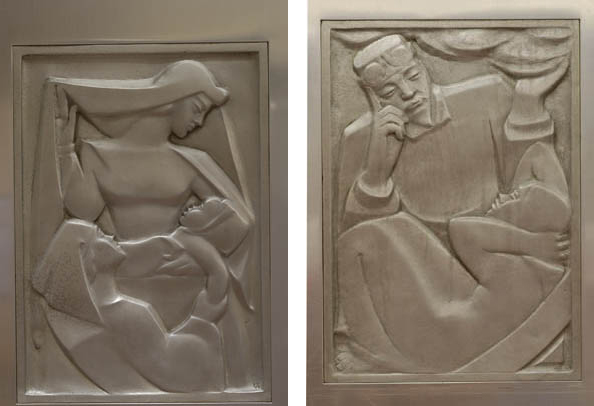
Metal plaques depicting Dorothea Lynde Dix (l), a pioneer in improved care for the insane, teaching a student nurse how to care for a child, and Dr. Sigmund Freud ® "pushing the clouds" from a patient's mind. Both are metal castings from the Magnuson Center's main elevator doors, which have been recreated as wall murals in the P1 lobby.
Both artists in their own right, Parmele and Fitzgerald seek out local and international artists’ works to display in rotating exhibit spaces throughout the Clinical Center as well as commission original works of art especially for the facility. When they find something they feel is a natural fit, they determine what pieces should go where, taking into account the size of the space and the environment in which it will be located.
Their latest and most challenging assignment was to find something to fill the walls of the P1 lobby in the new Hatfield Clinical Center. “Initially we didn’t know what to do with the space,” Fitzgerald says. “The walls are curved, which makes it particularly challenging. So we considered hanging banners for a time.” But one day, as the two were having coffee together, Parmele had what she calls her “Eureka moment.”
Parmele had continually come back to the images on the elevator doors in the Clinical Center’s original main lobby. The metal castings had been installed in 1953 with the opening of the Magnuson building and depicted symbolic moments in medical progress. Designed by Russian-American artist Vincent Glinksy, the images are a priceless and beautifully detailed piece of NIH history.
However, Parmele had been struggling with how to translate those images into something that would be large enough to fill the large walls, without looking too dark or gothic. She figured out the solution was a wall covering.
Immediately the two went to work with C.M. Beavan and Associates where Chuck Beavan began to piece together the technology, concept and product plans. When they proposed the idea to the CRC activation steering committee as a part of their overall art installation plan for the Hatfield Center the response was very supportive. “I believe we were the first people to ever receive an ovation at the steering committee,” Parmele laughs.
The project was then handed to Digital Arts Technology, Inc., where artist Rachael Scandarion fine-tuned and printed the final product, incorporating the warm colors and three-dimensional imagery that Parmele and Fitzgerald had been looking for. In May 2005, the printed wall murals were hung in the P1 lobby.
“The reliefs are a dramatic yet subtle integration of the old and new buildings,” says Dr. John Gallin, Clinical Center director. “Lillian Fitzgerald and Crystal Parmele are to be congratulated for the innovative use of the images on the elevator doors in the lobby of the Magnuson building to create a spectacular presentation for the new Hatfield Clinical Research Center. These beautiful images serve as a distraction from the pain and suffering associated with illness and help all who walk our halls focus on the hope that is offered by the work being done at the Clinical Center.”
“There is a real movement taking place in the arts and healthcare worlds,” Fitzgerald says. “We are coming from a concept of cleanliness, where hospital administrators thought hospitals needed to look clean and sterile and we have moved into something more comfortable and inviting,” Parmele continues.
Parmele and Fitzgerald have a number of other projects in the works. To read more about their other exhibits and the upcoming summer concert series, look for future issues of the Clinical Center News as we continue a multi-part series on the art of the Clinical Center.
– Kathryn Boswell