Clinical Center Art Series: Familiar images adorn Hatfield Clinical Center walls

Walk into most clinics or hospitals and you will be greeted with plenty of “corporate art.” You know the type. The photograph of a butterfly with the word, “Change,” emblazoned at the bottom. Or perhaps it is a sun-bleached poster-print of something that purports to be impressionism.

The artwork displayed throughout the Clinical Center, however, is nothing of the sort. There are exhibit spaces throughout the building that make visitors and passersby stop in their tracks, mesmerized by the color, detail, message and splendor. Every piece seems to naturally fit the space in which it is hanging or displayed and is uniquely relevant to the patients and staff that wait and work nearby. This is no accident-thanks to two women who labor tirelessly to bring culture and beauty to the halls of the Clinical Center. Crystal Parmele and Lillian Fitzgerald work in the Clinical Center Office of Facilities Management. Surrounded by offices full of blueprints and tools, their shared space is an island of vivid paintings, rolled canvases, and glass sculptures.
Clinical Center Art Series: Dorothea Lynde Dix

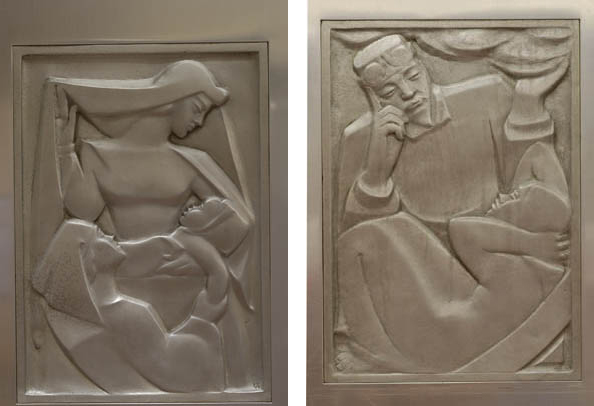
Metal plaques depicting Dorothea Lynde Dix (l), a pioneer in improved care for the insane, teaching a student nurse how to care for a child, and Dr. Sigmund Freud ® "pushing the clouds" from a patient's mind. Both are metal castings from the Magnuson Center's main elevator doors, which have been recreated as wall murals in the P1 lobby.

Both artists in their own right, Parmele and Fitzgerald seek out local and international artists’ works to display in rotating exhibit spaces throughout the Clinical Center as well as commission original works of art especially for the facility. When they find something they feel is a natural fit, they determine what pieces should go where, taking into account the size of the space and the environment in which it will be located.

Their latest and most challenging assignment was to find something to fill the walls of the P1 lobby in the new Hatfield Clinical Center. “Initially we didn’t know what to do with the space,” Fitzgerald says. “The walls are curved, which makes it particularly challenging. So we considered hanging banners for a time.” But one day, as the two were having coffee together, Parmele had what she calls her “Eureka moment.”

Parmele had continually come back to the images on the elevator doors in the Clinical Center’s original main lobby. The metal castings had been installed in 1953 with the opening of the Magnuson building and depicted symbolic moments in medical progress. Designed by Russian-American artist Vincent Glinksy, the images are a priceless and beautifully detailed piece of NIH history.

However, Parmele had been struggling with how to translate those images into something that would be large enough to fill the large walls, without looking too dark or gothic. She figured out the solution was a wall covering.

Immediately the two went to work with C.M. Beavan and Associates where Chuck Beavan began to piece together the technology, concept and product plans. When they proposed the idea to the CRC activation steering committee as a part of their overall art installation plan for the Hatfield Center the response was very supportive. “I believe we were the first people to ever receive an ovation at the steering committee,” Parmele laughs.

The project was then handed to Digital Arts Technology, Inc., where artist Rachael Scandarion fine-tuned and printed the final product, incorporating the warm colors and three-dimensional imagery that Parmele and Fitzgerald had been looking for. In May 2005, the printed wall murals were hung in the P1 lobby.

“The reliefs are a dramatic yet subtle integration of the old and new buildings,” says Dr. John Gallin, Clinical Center director. “Lillian Fitzgerald and Crystal Parmele are to be congratulated for the innovative use of the images on the elevator doors in the lobby of the Magnuson building to create a spectacular presentation for the new Hatfield Clinical Research Center. These beautiful images serve as a distraction from the pain and suffering associated with illness and help all who walk our halls focus on the hope that is offered by the work being done at the Clinical Center.”

“There is a real movement taking place in the arts and healthcare worlds,” Fitzgerald says. “We are coming from a concept of cleanliness, where hospital administrators thought hospitals needed to look clean and sterile and we have moved into something more comfortable and inviting,” Parmele continues.

Parmele and Fitzgerald have a number of other projects in the works. To read more about their other exhibits and the upcoming summer concert series, look for future issues of the Clinical Center News as we continue a multi-part series on the art of the Clinical Center.

– Kathryn Boswell
Hope flows from one patient to another in summer art tile project

Hope flows from one patient to another in summer art tile project: Collection

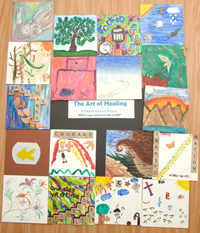
A collection of some of the tiles created for the project.

A treasure chest of frustration. A lone goldfish swimming in a bowl. The word “hope” stretched across a sunrise.

These are just a few of the themes of masonite tiles decorated by Clinical Center patients as part of a project called “The Art of Healing: The patient tile project.” The Recreation Therapy Section’s goal for the summer project, which ran from June through August, was to collect 100 tiles filled with images and phrases that capture the personal symbols of patient experiences at the CC.

Patients saw the process as a way to make a statement about their experience of illness, have their voice heard, and give a thing of beauty back to the CC community.

The tiles were made at a drop-in clinic on Monday mornings. Megan Robb, a board certified art therapist at the CC, and Natalie Haynes, a certified recreation therapist, traveled to patient units so that patients who must remain in bed, connected to medical devices, or in isolation had a chance to participate.

Robb stressed that the tile project had been collaborative with the CC community since the beginning. The tile installation design and title came from a patient who is a professional artist. Several 1NW nurses suggested displaying tiles made by pediatric patients on their unit. Other staff across units were very supportive of hosting art clinics to create tiles specific to patient experiences, such as receiving donated blood stem cell transfusions to treat cancer or fighting alcoholism or mental illness.

The tiles will be displayed in a flowing wall installation. The theme—hope flows from one to another—expresses the critical importance of the support from the community at the CC, not just from staff, but from the patients themselves. Through the tile project, patients described how they rely on each other for understanding, strength, and friendship.

Patients created their tiles from copper cut-out shapes, game pieces with letters, paint, and a texturized modeling paste. Robb, the CC art curators, and the CC art committee are still deliberating about how to best tell the stories that accompany the tiles. Some patients wrote short descriptions of the significance of their work. Others wanted to display their names on the tiles and contribute to a book of testimonials.

Family members, caregivers, and staff helped patients create their tiles. “Creating a piece of art together breaks down the traditional roles and boundaries between staff and patients and lets us interact in new ways,” Robb said.

Hope flows from one patient to another in summer art tile project: Art Therapists

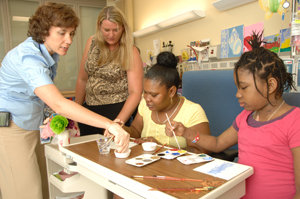
Megan Robb (left), a board certified art therapist, and Natalie Haynes, certified recreation therapist—both within the Rehabilitation Medicine Department's Recreation Therapy Section—help patient Danielle Harriott and her mom, Cassandra Christopher, create tiles for the project that remind them of their home in Kingston, Jamaica.

According to Robb, the tile project was a therapeutic art activity—it had a theme and an end product. Art therapy, on the other hand, is a client-driven process with an unknown destination that is rarely displayed in public. Although Robb believes that making art is an inherently healing process whatever the context, she feels that a particularly important aspect of this project was the opportunity for patients to communicate their experience to CC physicians and staff.

“It’s a good visual reminder for staff that receiving care here can be a simultaneously fearful and hopeful experience, where our patients may alternate between feeling powerful and vulnerable as they progress through their journey,” Robb said.

CC patient Danielle Harriott and her mom, Cassandra Christopher, created tiles for the project that remind them of their home in Kingston, Jamaica, which they have been away from for more than a year. They painted the green-blue color of the ocean, the white sandy beaches, and their country’s flag.

“We’re very glad to be here,” Christopher said. “If we hadn’t come here, we would have lost Danielle already.”

by Jenny Haliski

‘Nature Boy’ pops up in Clinical Center courtyards

"Wrapped Legs," by Keith Sharp

"Wrapped Legs," by Keith Sharp. The toned silver gelatin print is part of the "Nature Boy" series at the CC.

No, you’re eyes aren’t deceiving you. There is an elf of sorts visiting the courtyards and walls of the Clinical Center, and he hopes to bring a smile to your face.

His name, or the name of the series of photographs to be more precise, is “Nature Boy,” the work of Pennsylvania artist Keith Sharp. The exhibit includes 13 garden pieces from the “Nature Boy” series, which arrived in July, and eight framed wall pieces from other series by the artist that are coming to the Hatfield building’s west gallery in September.

The garden pieces came to the CC after gracing the greenery of the US Botanic Garden, which pressed the black-and-white photos between humidity-proof Plexiglas and placed them on stakes to create a whimsical juxtaposition of man and nature.

Lillian Fitzgerald, who works in the CC Office of Facilities Management as curator of the art exhibits, brought Sharp’s work to Building 10 as part of the CC’s art program, which includes eight galleries with rotating exhibits and a permanent collection of approximately 2,000 original works of art.

The “Nature Boy” series combines Sharp’s interests in nature and self-portraiture by transforming himself into a tree creature, an image influenced by Greek and Roman mythology of people transforming into trees, the Druids, and Native American transformation stories. The framed wall pieces are photographs from other series that also contain humor and surrealistic elements.

Sharp said many people respond to the humor in his work, which he hopes will allow people to forget about their problems, if only for a little while, and bring joy to CC patients, visitors, and staff.

"Running" by Keith Sharp

"Running" by Keith Sharp

The element of surprise and mystery in Sharp’s visual puns is intentional. Although he documented the world in a straightforward way when he started in photography, Sharp soon began to tease the quirky elements out of his pictures and create staged, conceptual images. He now begins each series by sketching various ways that he can transform the everyday world through his imagination and make his viewers do a double-take.

The props and costumes Sharp assembled for his “Nature Boy” performances, of which a photograph is the end result, were created from natural and artificial materials, including bark, leaves, flowers, old clothes, fabric, plastics, paint, and glue.

“Juxtaposing elements within the photographs as well as between two photographs, I attempt to make the viewer look at ordinary life in new and unique ways. I am interested in pointing out the irony and contradictions in life—not everything is what it seems,” he said.

Both portions of the exhibit leave the CC in November, so commune with “Nature Boy” while he’s here.

Local artist inspired to donate painting after sharing NIH connection

"If You Believe, You Get First Choice" by Carol Brown Goldberg

Local artist Carol Brown Goldberg donated the painting pictured above titled "If You Believe, You Get First Choice," to the CC this February. It hangs on the seventh floor of the Hatfield building.

Artist Carol Brown Goldberg understands the importance of art in an environment dedicated to healing and medicine. “I think it is the most important place to put art,” she said.

Goldberg donated her painting “If You Believe, You Get First Choice” to the Clinical Center in February.

Goldberg’s decision was motivated by a chance meeting with the parent of a former CC patient, who approached her at an exhibit of Goldberg’s artwork in December. Goldberg recalls feeling moved as the woman spoke of the time she spent at the CC praying for her son who was battling cancer.

“She said she wished she had been able to see that painting,” Goldberg said, “that maybe it would have helped her and given her a sense of optimism.”

Goldberg herself spent a significant amount of time at the CC in 1979 when her son underwent successful open heart surgery here. After her recent coincidental encounter with a fellow mother and caregiver, she decided to donate the painting.

“I was profoundly inspired by that conversation,” she said. “We are both so fortunate that our sons are healthy. The NIH and art brought us together quite serendipitously.”

Goldberg has been exhibiting in Washington, DC since 1975. Her work has been inspired by science, the brain, and physics, and she has been exploring the relationship between art and science for many years in a variety of mediums.

Her painting “If You Believe, You Get First Choice” hangs in the Hatfield Building seventh floor bridge.

Former Patient’s Art explores inner and outer landscape

"River Cells" © by Paula Crawford

"River Cells" © by Paula Crawford

The most recent addition to the Clinical Center’s permanent art collection-a program to enhance the patient experience-comes from one of the target audience.

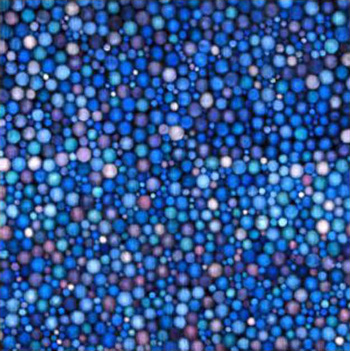
River Cells is an oil painting by former patient Paula Crawford, an associate professor of painting at George Mason University who has exhibited nationally and internationally.

“I’ve been an artist most of my adult life,” Crawford said. “That is what I’ve gotten up in the morning to do everyday.”

Some of those days were spent in the CC to participate in a protocol under Dr. Y aron Rotman from the Liver Diseases Branch of the National Institute of Diabetes and Digestive and Kidney Diseases for treatment of chronic Hepatitis C. Crawford cited a contaminated gamma globulin shot received before a trip to Mexico as the probable source of her infection.

Despite the taxing treatment regime, Crawford said, “I had the best medical care that I have ever experienced in my life … Everywhere at the Clinical Center-the liver clinic, phlebotomy, and elsewhere-! encountered a rare and unparalleled combination of organization, competence, and kindness.”

While around the building, her artist’s eye noticed the aesthetics. “The care to the physical building coupled with that of the doctors and staff become critical to a kind of total experience the patient receives.”

To add to the CC’s collection, Crawford painted River Cells in a few months. “I was trying to make a painting that both felt like watching river stones beneath rushing water (outside landscape), but also somewhat like looking through a microscope (interior landscape),” she said. The piece will hang in the Hatfield Building’s seventh floor breezeway.

“I hope that the art work inspires patients and co-workers the way Paula’s courage and determination inspired me,” Rotman said.