

The details and colors of Hoshino's watercolors capture the attention of passersby.
With eight galleries featuring changing exhibits and a permanent collection of approximately 2,000 original works of art displayed throughout the CC building, the art program is a substantial undertaking. And when joined with the other programs currently offered, including a new summer concert series, the Clinical Center is rich with cultural immersion opportunities.
One of the exhibits currently on display is the artwork of Japanese artist and poet Tomihiro Hoshino. In 1972, Hoshino was working as a physical education teacher at a junior high school in Japan when he injured his neck in a gymnastic lesson and was left paralyzed from the neck down. During his nine years in the hospital, he learned to paint by holding a paintbrush between his teeth. It was this talent and his faith that gave Hoshino hope for the future. His beautiful watercolors of flowers are complemented by his accompanying poems, which give a glimpse into the challenges of his condition and his deep sense of joyful hope.
One watercolor’s accompanying poem reads, “They went through a dark long period under the ground. They sprouted at great risk to life. But blades of grass show us the most beautiful figure of their lives without a single word of such part.”
When Hoshino’s work came to the Clinical Center for display, it was originally intended only as a temporary exhibit. However, when he read the endless comments NIH visitors, patients and staff had written in the exhibit’s guest book [visit www.cc.nih.gov/ccc/ccnews/current/ to read some of the comments], he was extremely moved. “He was so impressed by how Americans responded to his art that he donated the entire exhibit to the Clinical Center,” says Lillian Fitzgerald who works in the CC office of facilities management.
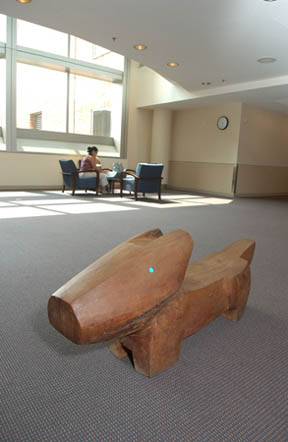
The "red dog," as he is commonly known, greets third–floor Hatfield Center visitors.
The Hoshino exhibit is now permanently displayed on the fifth floor of the Hatfield Center. Today, Fitzgerald and her colleague Crystal Parmele are keeping a close eye on the CC’s public spaces. In addition to displaying art, the duo is creatively and artistically addressing challenges posed by the building itself. For example, the curved walls of the P1 entrance lobby now display replicas of the elevator door reliefs from the old building.
Many of the works of art they select for rotating exhibits are works by local artists. “We concentrate on local artists’ work,” says Fitzgerald. “Even for our summer concert series we encourage NIH staff who play instruments or sing to perform. Many of them have such talent and such wonderful stories to tell, but they have never performed. Through projects like this, we can help in a gentle way.” By showcasing local talent, the CC Art Program helps new artists find their start, but it also cultivates important relationships with members of the external community.
In addition, many of the artists’ works go on to be part of NIH’s touring exhibits, which are displayed in such prominent locations as the United States Botanic Garden, the secretary of Health and Human Services’ reception area in Washington, D.C., and the Washington Cancer Center. The artworks on display in the Clinical Center galleries are available for purchase and 20 percent of the sale proceeds are donated to the Patient Emergency Fund. Prices can be obtain-ed from the Clinical Center hospitality stations as well as from the art program office.
“I am glad this is a public building,” says Parmele. “Because we can expose people to art and music who would otherwise not have the opportunity. In the same way, we do not want people to be intimidated by art. Many people have made their first purchase of an original work of art from the Clinical Center galleries.”
If you are interested in purchasing a piece of art currently on display in one of the Clinical Center’s galleries, contact Lillian Fitzgerald, curator, at (301) 594-5923, (703) 836-1231, or e-mail vog.hin.ccnull@dlaregztifl.
– Kathryn Boswell